
A temperature-sensitive shipment can leave the manufacturer in exactly the right condition and still face a difficult journey. There may be a collection window to meet, a road leg before the flight, a change of handler at the airport and several hours between arrival and the next controlled storage point. Each stage has its own timetable, people and operating conditions.
That is what makes temperature controlled logistics more than a transport booking. The job is to understand the conditions the product needs, then make sure the route, handling arrangements and thermal protection are planned around those requirements from dispatch to receipt.
What does temperature-controlled logistics involve?
Temperature controlled logistics is the planning and management of storage, handling and movement for goods that need to remain within defined temperature conditions. The products may be pharmaceuticals, biological materials, specialist chemicals or other sensitive goods. Some require refrigeration. Others have controlled room temperature requirements or need protection from heat and freezing during exposure to the outside environment.
A temperature requirement should come from the product specification, not from the assumption that every sensitive shipment belongs in the same cold chain. It also helps to distinguish the required condition of the product from the air temperature outside the load. A warm loading dock does not automatically mean a product has experienced an excursion, but it is an exposure that needs to be understood.
Start at origin, before the freight moves
The first useful conversation happens well before a carrier arrives. What temperature range applies? How sensitive is the product to short exposures? What is the load configuration? Who is responsible for the freight while it is being staged and where will it wait if collection is delayed?
These answers influence the choice of vehicle, the handling instructions and the protection placed around the shipment. They also help the shipper decide what evidence will be needed. A high-value pharmaceutical shipment with defined stability requirements may need route qualification and a documented monitoring process. Another temperature-sensitive product may have different tolerances and operational controls.
It is worth checking the departure environment as well. Goods can spend time in a dispatch area after leaving controlled storage. If that area is warmer or colder than the required condition, the exposure has already begun before the journey appears to have started on the freight schedule.
Plan the journey people will actually carry out
A route on paper often looks simple: warehouse, truck, airport, aircraft, truck, receiver. In practice, each change of transport introduces a set of smaller activities. Freight may be queued, unloaded, checked, moved across a terminal or held until a connection becomes available.
Effective temperature controlled transport planning accounts for those activities and the people responsible for them. It should be clear which stages are actively temperature controlled, which involve temporary exposure and what happens when the expected timetable changes. A route through several countries may also bring seasonal and climatic differences that are not obvious from the point of origin.
A practical route review asks how long the shipment could spend outside a controlled environment, where that is most likely to happen and what alternatives are available if the next stage is missed. This is a more useful basis for protection than assuming every movement will follow its fastest possible schedule.
Some journeys use powered refrigeration or temperature-controlled vehicles and containers to manage the environment around the freight. Passive solutions have a different role. They can slow the movement of unwanted heat into or out of the protected load, which may be useful during handling, short exposure periods and transfers between controlled stages.
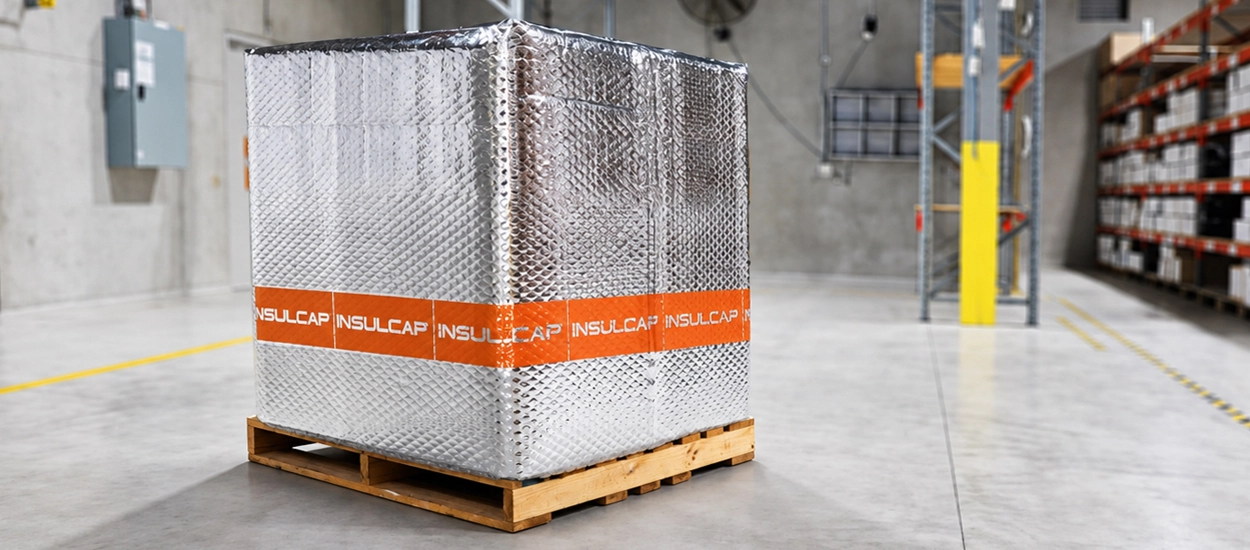
We develop passive thermal protection for these conditions. InsulCap® is designed for palletised loads, while InsulBox® provides a custom thermal liner for smaller box-level shipments. Our Insul® Technology uses reflective and insulating layers to help reduce radiant, conductive and convective heat transfer. The format should follow the load and route, rather than being selected simply because a cover or liner is available.
Passive thermal protection is not a powered cooling system. Its performance depends on the starting condition of the product, the exposure profile, the configuration and the time involved. For some products and routes, active control remains necessary throughout the journey. Other operations may use passive protection alongside controlled transport at vulnerable stages.
Use monitoring to understand the journey
Temperature monitoring can show what the product or its surrounding environment experienced, provided the devices and their placement are appropriate for the application. The information is especially useful when a delay or unexpected exposure needs to be assessed. A record of conditions is more informative than a note saying the freight arrived late.
For pharmaceutical movements, World Health Organization distribution guidance discusses route profiling, shipping-system qualification and monitoring as part of managing time- and temperature-sensitive products. Local requirements and product specifications still take precedence. Monitoring provides evidence for assessment; it does not, by itself, keep a shipment within range.
Make the receiving stage part of the plan
Delivery is not complete when the vehicle reaches the gate. The freight may need to be checked, unloaded, moved through a receiving area and transferred into its intended storage conditions. A receiver who knows the product requirements and expected arrival window can prepare for that final stage.
The same principle applies to deviations. If a logger records an unexpected temperature, the receiving team needs an agreed process for reviewing the evidence and deciding what happens next. A thermal cover cannot make that quality decision on its own.
Bringing the route together
Good temperature controlled shipping relies on a clear understanding of the product and a realistic view of the journey. Route planning, responsible handlers, suitable equipment, thermal protection and monitoring all contribute, but they do different jobs. The strongest approach is one in which each part is selected for the conditions the shipment is likely to face.
We work with organisations transporting temperature-sensitive products to consider where temperature-sensitive freight may be exposed and what passive thermal protection is appropriate for the load. If you are reviewing a route or planning a new movement, talk to our team about the shipment configuration, likely exposure points and the protection options available.
Frequently asked questions
Can a thermal cover replace temperature-controlled transport?
A passive cover can reduce heat transfer, but it does not actively heat or cool the load. Whether it is suitable without active equipment depends on the product, route, duration and supporting performance evidence.
Why should route planning include time outside controlled storage?
Loading, transfers, temporary holds and receiving can expose freight to conditions that differ from those in controlled facilities. Those stages can influence the overall thermal risk even when the main transport leg is managed carefully.