
In the pharmaceutical industry, the journey doesn’t end when a life-saving product leaves the production line. In many ways, that is only the beginning of its most critical stage: the supply chain.
Every shipment represents far more than inventory. It represents patient well-being, regulatory trust, and the hard-won reputation of the organisation behind it. And right now, the industry is losing more than $35 billion every year to a problem that validated thermal protection can directly address – temperature excursions in transit.
Pharma supply chain leaders today face a threefold challenge:
- protecting the financial value of every shipment.
- safeguarding the brand reputation built over decades.
- maintaining compliance in an increasingly rigorous regulatory environment.
This is where validated thermal pallet covers and pallet insulation solutions play a decisive role.
The Scale of the Problem: What Temperature Excursions Actually Cost
A temperature excursion is not an edge case. It is one of the most common and costly failure modes in global pharmaceutical logistics, occurring when temperature-sensitive products are exposed to conditions outside their validated storage range during transport, even briefly.
The consequences cascade quickly. A single compromised shipment can mean wasted product batches, delayed patient treatments, disrupted distribution networks, regulatory investigations, and the kind of reputational damage that takes years to repair. Multiply that across a global supply chain operating at volume, and the $35 billion annual figure becomes easier to understand.
What makes excursions particularly damaging is that many are preventable. Tarmac exposure during loading and unloading. Delays at customs. Rerouted flights. Unplanned overnight storage in non-temperature-controlled facilities. These are known, foreseeable risks and the right thermal pallet cover or insulated pallet blanket solution addresses all of them.
1. Protecting the Financial Value of Every Pharmaceutical Shipment
The financial risks embedded in pharmaceutical cold chain logistics are significant at every level. High-value biologics, vaccines, and specialty medicines represent enormous per-unit costs. When a batch is compromised due to thermal excursion, the direct financial loss is only part of the picture.
The downstream costs of regulatory investigation, batch disposal, patient supply disruption, re-manufacturing, and logistics rescheduling frequently dwarf the value of the original shipment. For temperature-sensitive products with complex manufacturing lead times, a single excursion event can create supply gaps that persist for months.
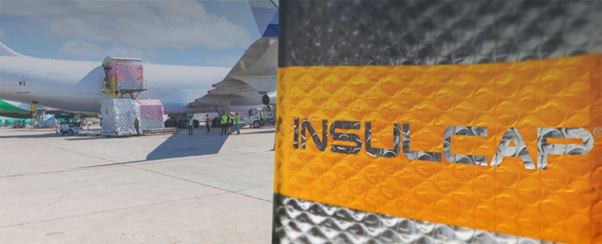
InsulCap® thermal pallet covers from Wilpak Group International are designed specifically to protect against these risks. Lightweight, scalable, and validated across global shipping routes and ambient conditions, InsulCap® delivers extended temperature stability in real-world environments. Its seven-layer Insul® Technology reflects radiant heat and reduces conduction and convection, maintaining safe internal pallet temperatures across the loading delays, tarmac exposures, and transit variability that pharmaceutical shipments routinely encounter.
Every shipment protected by a validated thermal pallet cover is a batch that reaches the patient. Every unprotected excursion is a risk that doesn’t have to exist.
2. Safeguarding the Reputation Built Over Decades
Trust in pharmaceutical supply chains is built over years of consistent, documented performance. It can be undermined by a single shipment that arrives outside specification.
When temperature-sensitive medicines reach their destination compromised, it is not only the product that fails, it is the brand promise. Healthcare providers, hospital pharmacies, and regulatory bodies all draw conclusions from excursion events. A pattern of cold chain failures signals systemic inadequacy in a way that is very difficult to reverse.
By integrating InsulCap® thermal pallet covers into standard supply chain operations, pharmaceutical companies demonstrate to every stakeholder, from procurement partners to regulatory auditors, that patient safety and product quality are genuinely non-negotiable. Each protected shipment builds an evidence base of reliability. Each excursion prevented is a reputational risk that never materialises.
The documentation that comes with a validated pallet insulation solution matters here as well. ASTM-tested performance data, real-world shipping trial results, and consistent thermal stability records give quality assurance teams the documented evidence they need to demonstrate supply chain integrity.
3. Turning Compliance from a Vulnerability into an Advantage
Global regulations governing the transport of temperature-sensitive pharmaceuticals are becoming more stringent, not less. GDP (Good Distribution Practice) requirements, WHO prequalification standards, and regional regulatory frameworks across the EU, US, and Asia-Pacific all demand documented evidence that temperature-sensitive products have been protected throughout the supply chain.
Non-compliance carries serious consequences: product recalls, import restrictions, regulatory fines, and the long-term reputational damage of a public enforcement action. For pharmaceutical companies operating across multiple markets, maintaining compliance simultaneously across different regulatory regimes adds another layer of complexity.
InsulCap® thermal pallet covers are validated to military performance specifications and tested in collaboration with global regulatory and research experts. This level of validation provides the regulatory confidence that procurement and quality assurance teams need across diverse international markets, transforming thermal pallet protection from a compliance vulnerability into a documented compliance advantage.
InsulBox® pallet insulation box liners provide the same validated Insul® Technology for smaller shipment configurations, ensuring that compliance-grade thermal protection extends to individual carton and unit-level packaging as well as full pallet consignments.
Validated pallet insulation doesn’t just protect your product. It protects your licence to operate.
Why the Right Thermal Protection Strategy Matters Now
The pharmaceutical supply chain is not simply a logistics function. It is a mission-critical ecosystem on which patient access to life-saving medicines directly depends, and the risks embedded in that ecosystem are growing.
Climate volatility is increasing the frequency and severity of ambient temperature extremes that thermal pallet covers must contend with. Supply chain complexity is rising as pharmaceutical distribution networks extend into more markets with more varied infrastructure. And regulatory scrutiny is intensifying as health authorities worldwide raise the evidentiary bar for temperature control documentation.
In that environment, the question for pharmaceutical supply chain leaders is not whether validated thermal pallet protection matters. It is whether the pallet insulation solutions currently in use have been genuinely validated for the worst-case conditions your shipments face, or simply specified for average ones.
Wilpak Group International has spent 22 years answering that question with data, not assumptions. Our InsulCap® and InsulBox® solutions have been validated across routes, climates, and regulatory frameworks on four continents because protecting temperature-sensitive goods is not about what’s inside the box alone. It is about protecting what matters most: patient health, regulatory trust, and the reputation of the organisations that have earned both.
Frequently Asked Questions: Pharmaceutical Cold Chain & Thermal Pallet Protection
What is a temperature excursion and why does it matter for pharmaceuticals?
A temperature excursion occurs when a temperature-sensitive product is exposed to conditions outside its validated storage range during transport or storage, even temporarily. For pharmaceuticals, excursions can compromise product efficacy, trigger mandatory regulatory investigations, and in serious cases require full batch disposal. They are one of the leading causes of pharmaceutical product loss globally.
How do thermal pallet covers prevent temperature excursions?
Thermal pallet covers create an insulated barrier around palletised pharmaceutical goods, reducing the rate at which external temperature changes affect the internal environment. Wilpak’s InsulCap® uses seven-layer Insul® Technology to reflect radiant heat and reduce thermal conduction and convection, maintaining safe temperatures during tarmac exposure, loading delays, and unplanned transit interruptions.
What validation standards does InsulCap® meet?
InsulCap® thermal pallet covers are validated to ASTM testing standards and military performance specifications, and have been tested in collaboration with global regulatory and research experts. Wilpak publishes real-world trial data including validated shipping simulations to provide documented performance evidence for quality assurance and regulatory teams.
How does pallet insulation support GDP compliance?
GDP (Good Distribution Practice) requires pharmaceutical distributors to maintain documented evidence that temperature-sensitive products have been stored and transported within validated conditions. Validated thermal pallet covers like InsulCap® provide the performance data and audit trail that support GDP documentation requirements across EU, US, and international regulatory frameworks.
What is the difference between InsulCap® and InsulBox® for pharmaceutical logistics?
InsulCap® is a full-pallet thermal cover designed for palletised pharmaceutical shipments, particularly suited to air freight and scenarios involving tarmac exposure or extended loading delays. InsulBox® uses the same Insul® Technology in a box liner configuration for smaller shipments, individual cartons, or unit-level protection. Both are validated to the same performance standards.
Can InsulCap® be used across multiple transport modes?
Yes. InsulCap® thermal pallet covers are validated for use across air freight, sea freight, and road transport, accounting for the different ambient conditions, humidity profiles, and handling variability associated with each mode. Wilpak’s global deployment experience spans four continents and a wide range of climate zones.