
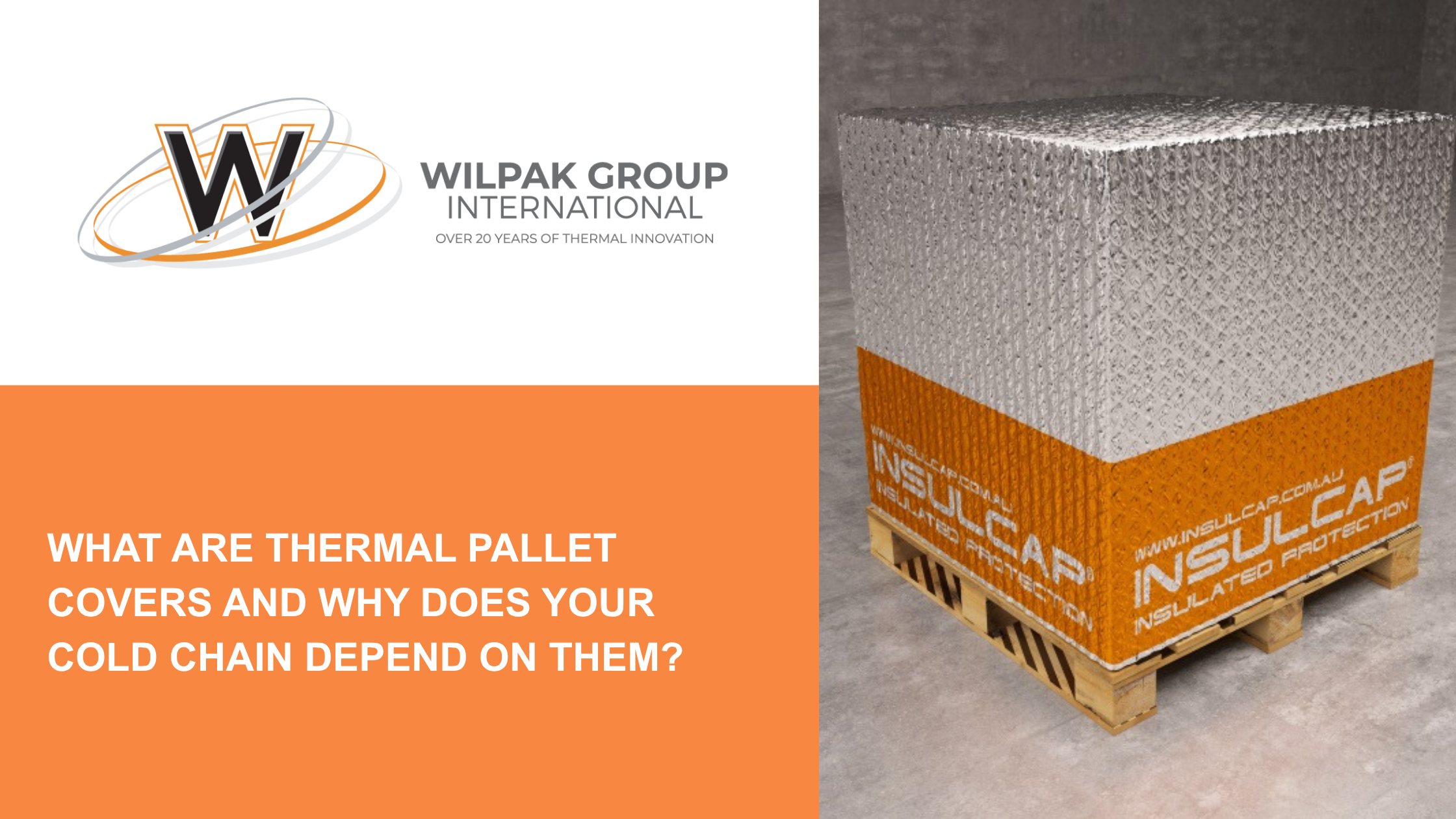
Thermal pallet covers are insulated protective covers placed over palletised goods during transport and storage to maintain safe internal temperatures by blocking radiant heat, reducing thermal conduction, and preventing convective heat transfer. They are the primary line of defence against temperature excursions in cold chain logistics and the difference between product that arrives in specification and product that doesn’t.
If you move temperature-sensitive goods such as pharmaceuticals, biologics, fresh food, cosmetics, or any product with a defined storage temperature range then your cold chain depends on what happens between the controlled environment of a warehouse and the controlled environment of its destination. That gap is where thermal pallet covers do their job.
What Is a Thermal Pallet Cover?
A thermal pallet cover is an engineered insulation solution that fits over a standard pallet of goods, creating a contained thermal environment around the product. Unlike refrigerated transport, which actively generates cold, a thermal pallet cover works passively — slowing the rate at which external temperature changes affect the internal temperature of the pallet.
The best thermal pallet covers use multiple layers of specialised materials to address the three distinct ways heat moves: radiation, conduction, and convection. Addressing only one or two of these mechanisms leaves your cargo exposed. Addressing all three is what defines a genuinely protective thermal pallet cover.
You may also encounter the terms pallet blanket, insulated pallet blanket, or thermal blanket for pallets. These are often used interchangeably with thermal pallet cover, though as we explain in our companion post, there are meaningful differences between a basic pallet blanket and an engineered thermal cover solution.
The Three Heat Threats Your Cold Chain Faces
Understanding why thermal pallet covers matter requires understanding how heat actually moves and how each mechanism threatens your cargo.
Radiant Heat
Radiant heat is thermal energy transmitted through electromagnetic waves without requiring physical contact or air movement. It is the heat you feel from the sun without touching anything. On an airport tarmac in summer, radiant heat from the sun and from the tarmac surface itself can raise the ambient temperature around a pallet significantly — even in the shade.
A high-quality thermal pallet cover uses reflective outer layers to bounce radiant energy away from the pallet before it can penetrate to the product. This is why solar reflectivity is one of the most important performance specifications to look for in a thermal pallet cover — and one of the most frequently overlooked.
Conductive Heat
Conductive heat transfer occurs when thermal energy moves through direct physical contact between materials. When a pallet sits on a hot tarmac surface, heat conducts upward through the pallet base into the goods. When a cold pallet is placed in a warm environment, heat conducts inward through whatever is touching the exterior of the load.
Effective thermal pallet covers incorporate insulating layers that interrupt the conductive pathway — materials with low thermal conductivity that slow the movement of heat through contact.
Convective Heat
Convective heat transfer occurs through the movement of air. Warm air flowing around or into a pallet load carries thermal energy directly to the product surface. In environments where temperature differentials are significant — a loading dock with doors open to a hot exterior, for example — convective heat can move surprisingly quickly.
A well-designed thermal pallet cover minimises air movement within the enclosed pallet environment, reducing the rate of convective heat exchange.
A thermal pallet cover that addresses only one or two of these heat transfer mechanisms is not a complete solution. Radiant, conductive, and convective heat must all be managed simultaneously.
Why the Cold Chain Has Gaps — and Why They Matter
The cold chain is rarely continuous. Between the controlled-temperature manufacturing facility and the controlled-temperature storage destination, temperature-sensitive goods pass through a series of environments that are neither controlled nor predictable.
Airport tarmacs. Loading docks. Transfer facilities. Customs holding areas. The cargo hold of an aircraft during a ground delay. The back of a truck during an unexpected route change.
Each of these represents a potential temperature excursion event — a period during which the product is outside its validated storage range. Industry research suggests up to 20% of temperature-sensitive pharmaceutical products experience some form of temperature excursion during transit. The consequences range from reduced product efficacy to complete batch loss, regulatory investigation, and supply disruption for the patients or customers at the end of the chain.
Thermal pallet covers exist specifically to extend the time a pallet of goods can maintain safe internal temperatures through these unavoidable gaps — buying the buffer that prevents a delay from becoming a loss.
What Makes InsulCap® Different
InsulCap® from Wilpak Group International is a thermal pallet cover built to US Military and UK MOD specifications — the most demanding performance benchmarks in materials science. Where many thermal covers address heat transfer partially, InsulCap®’s seven-layer Insul® Technology addresses all three heat transfer mechanisms simultaneously.
The seven-layer construction combines high solar reflectivity outer layers, insulating mid-layers, and an enclosed air gap to reflect radiant energy, interrupt conductive pathways, and reduce convective exchange — creating a validated thermal barrier around the full pallet.
InsulCap® is the only thermal pallet cover specifically engineered for air freight, where tarmac exposure, cabin pressure changes, and loading delays create some of the most challenging thermal conditions in logistics. It is available in three configurations — InsulPlatinum®, InsulGold®, and InsulPrime® — to suit varying performance requirements, transit durations, and ambient conditions.
InsulCap® can also be custom-sized to fit non-standard pallet configurations, and its flat-pack design reduces storage and inbound transport costs.
Who Uses Thermal Pallet Covers?
Thermal pallet covers are used across any industry where product integrity depends on temperature stability during transport and storage:
Pharmaceutical and Biotech — vaccines, biologics, specialty medicines, and clinical trial materials all require documented temperature control throughout the supply chain. GDP (Good Distribution Practice) compliance demands validated thermal protection at every point of potential excursion.
Food and Beverage — fresh produce, premium chocolate, wine, dairy, and other perishables are vulnerable to both heat and cold excursion. A single thermal event can cause spoilage, bloom, or quality degradation that makes product unsaleable.
Cosmetics and Luxury Goods — fragrances, skincare formulations, and premium beauty products can be chemically affected by heat exposure. For luxury brands, the reputational cost of a compromised delivery adds to the direct product loss.
Chemicals and Specialty Materials — certain chemical compounds and specialty materials have defined temperature windows for safe transport that thermal pallet covers help maintain.
How to Choose the Right Thermal Pallet Cover
Not all thermal pallet covers perform equally. When evaluating options, the key specifications to look for are:
Solar reflectivity rating — the higher the reflectivity, the more radiant energy the cover bounces away before it reaches the product. Look for ASTM-tested reflectivity data, not manufacturer estimates.
Number of insulation layers — multi-layer construction addresses more heat transfer pathways than single or dual-layer designs.
Performance validation — has the product been tested under real-world conditions, not just laboratory simulations? Ask for shipping trial data and ASTM test results.
Military or regulatory specification compliance — US Military and MOD specification materials are tested to the most demanding performance standards available.
Custom sizing and fit — a thermal pallet cover that fits correctly performs significantly better than one that doesn’t. Gaps, folds, and poor closures create thermal bridges that undermine the insulation system.
End-of-life recyclability — particularly relevant for high-volume operations with sustainability commitments.
Frequently Asked Questions: Thermal Pallet Covers
What is a thermal pallet cover? A thermal pallet cover is an insulated cover placed over a pallet of goods to maintain safe internal temperatures during transport and storage. It works by reflecting radiant heat, reducing thermal conduction, and minimising convective heat transfer — the three mechanisms by which heat moves into or out of a pallet load.
What is the difference between a thermal pallet cover and a pallet blanket? The terms are often used interchangeably, but there are meaningful distinctions. A pallet blanket typically refers to a basic insulating wrap, while a thermal pallet cover implies a more engineered, multi-layer solution validated for specific performance standards. See our full comparison post: [Pallet Blankets vs. Thermal Pallet Covers: What’s the Difference?]
How long can a thermal pallet cover maintain temperature? This depends on the specific product configuration, the ambient temperature exposure, and the thermal mass of the goods. InsulCap® configurations have been validated across transit durations including a 77-hour simulated air freight route from Melbourne to Chicago, maintaining products within a 0–30°C range throughout.
Are thermal pallet covers reusable? Yes. High-quality thermal pallet covers like InsulCap® are designed for repeated use. The military-grade materials are built to maintain performance across multiple deployments, reducing per-shipment cost and total material consumption.
Do thermal pallet covers replace refrigerated transport? Not in all cases — but for certain routes and durations, validated thermal pallet covers can reduce or eliminate the need for refrigerated vehicles, particularly for short-haul road transport. The appropriate solution depends on the product’s temperature requirements, transit duration, and ambient conditions.
What does GDP compliance mean for thermal pallet covers? GDP (Good Distribution Practice) requires that temperature-sensitive pharmaceutical products are transported and stored within validated conditions, with documented evidence. A GDP-compliant thermal pallet cover solution provides the validated performance data and audit trail that quality assurance and regulatory teams require.
Can thermal pallet covers be used for air freight? Yes — and for air freight specifically, an engineered thermal pallet cover is particularly important. Tarmac exposure, loading delays, and cabin pressure changes create demanding thermal conditions. InsulCap® is the only thermal pallet cover specifically designed and validated for air freight environments.
Explore InsulCap® thermal pallet covers at wilpakgroup.com/insulcap or contact the Wilpak team to discuss your cold chain requirements.